Services
What we print.
01
Banners and tarpaulins
We print PVC frontlit for single-sided banners and blockout material for visuals readable from both sides. Typical uses are façades, car dealerships, events and promotional areas on site; finishing includes hems, eyelets, pole pockets or keder.
02
Mesh banners
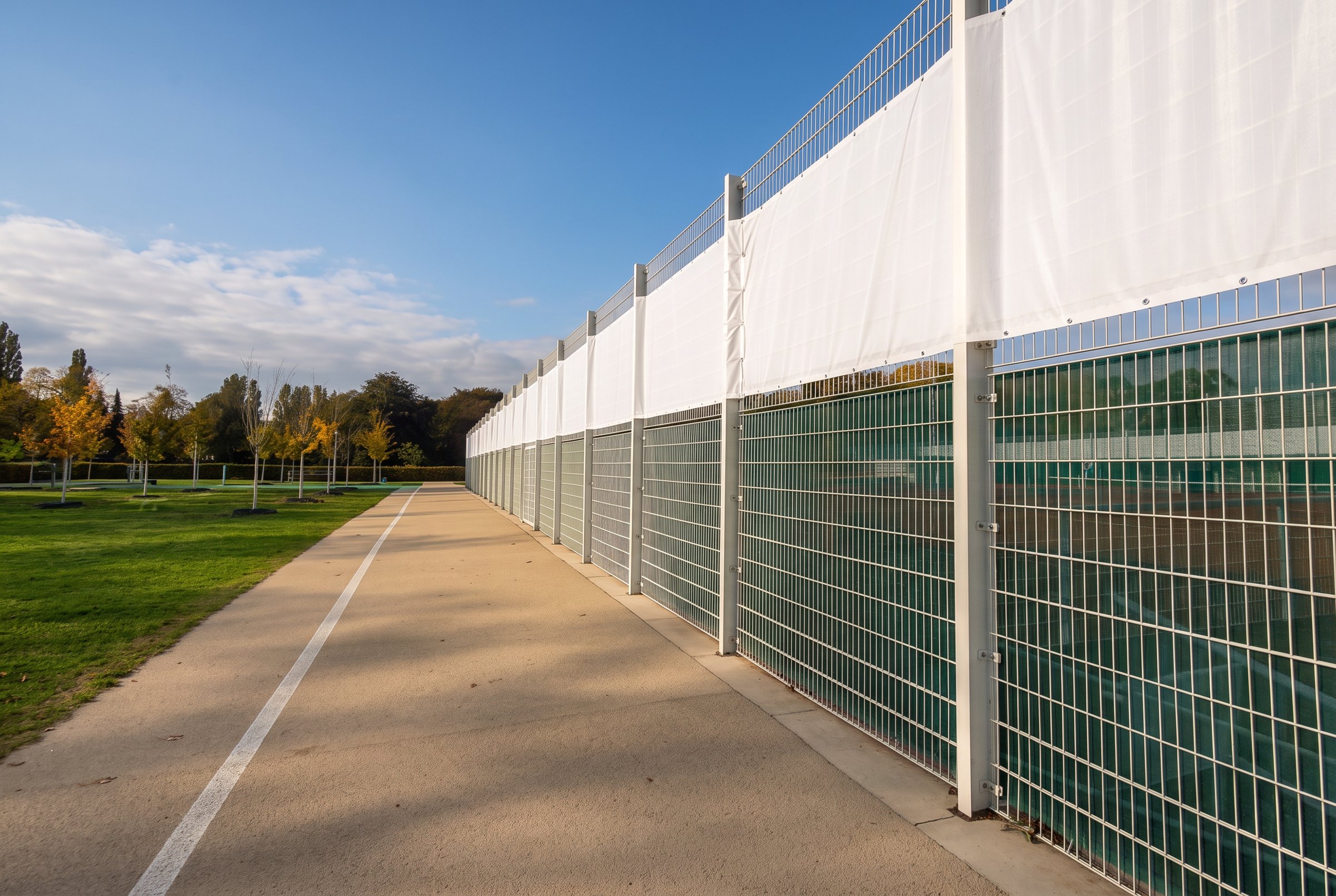
Mesh banners consist of a coated mesh fabric that lets wind through and so relieves scaffolding, fence and fixings. They are suitable for scaffolding, sports facilities, fences and large façade areas.
03
Construction fence banners
We print construction fence banners to fit the standard fence panel of 3.50 × 2.00 m, as single banners or as a continuous visual across many panels. Depending on the location we recommend mesh or solid tarpaulin and supply the banners with eyelets all round for fixing to the fence.
04
Backlit and light box graphics
For backlit advertising spaces we print translucent backlit material and backlit textiles. The print is matched to the illumination so that colours stay strong even when the light is on.
05
Textile printing and tension fabrics
Printed polyester fabrics with a sewn-in keder are fitted into aluminium tension frames and are easy to swap when the visual changes. This suits retail spaces, shop windows, offices and trade fair stands where visuals change regularly.
06
Rigid board printing
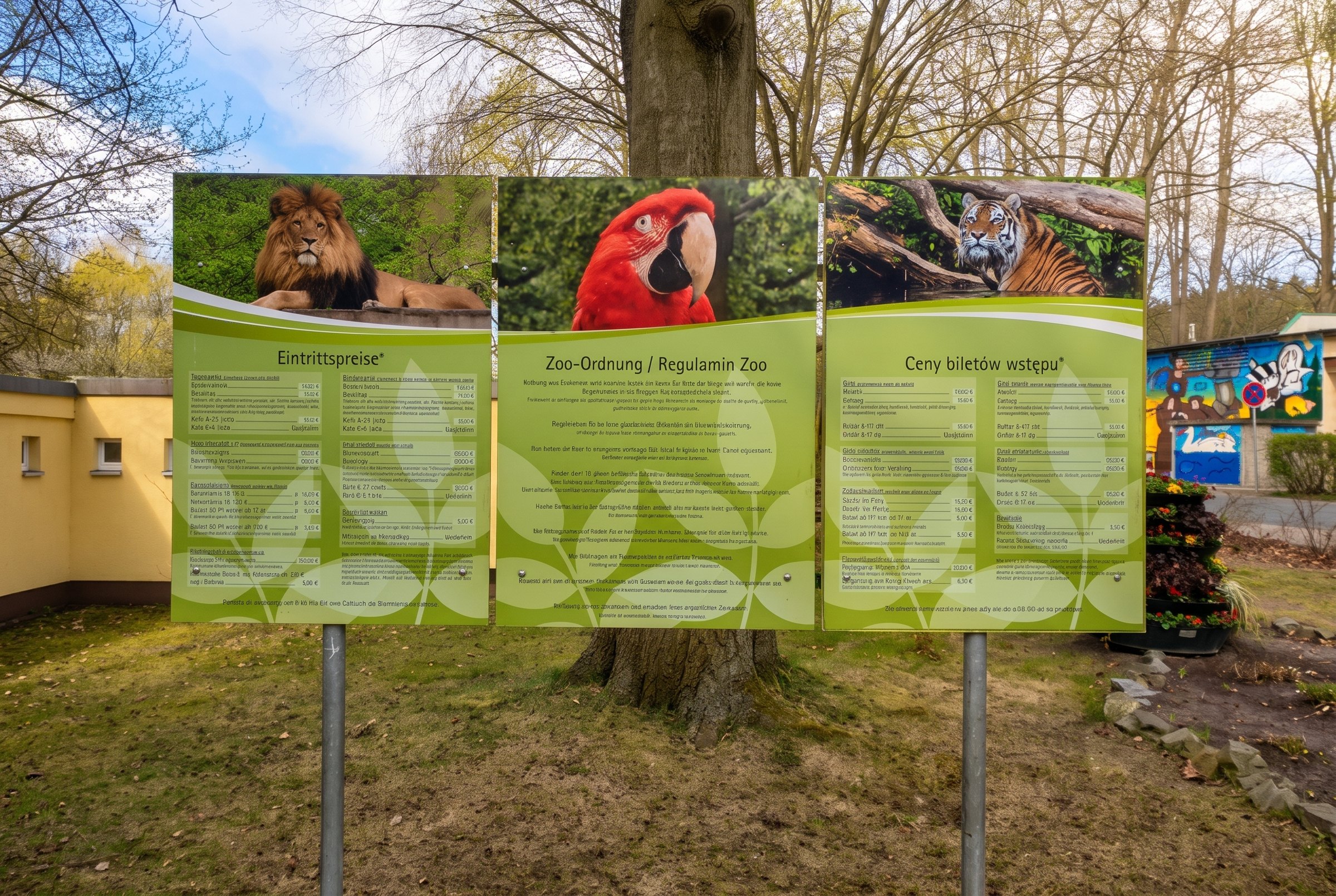
We print directly onto aluminium composite panels and rigid PVC foam boards (Forex) and mill them to size or to contour. The result is signs, site boards, wall cladding and displays for the sales floor.
07
Film and digital printing
We print self-adhesive films for shop windows, walls, floors and vehicles, with protective laminate and contour cut on request. We choose the film according to the substrate and duration of use so that it holds and can be removed again later.
08
XXL formats and façade banners
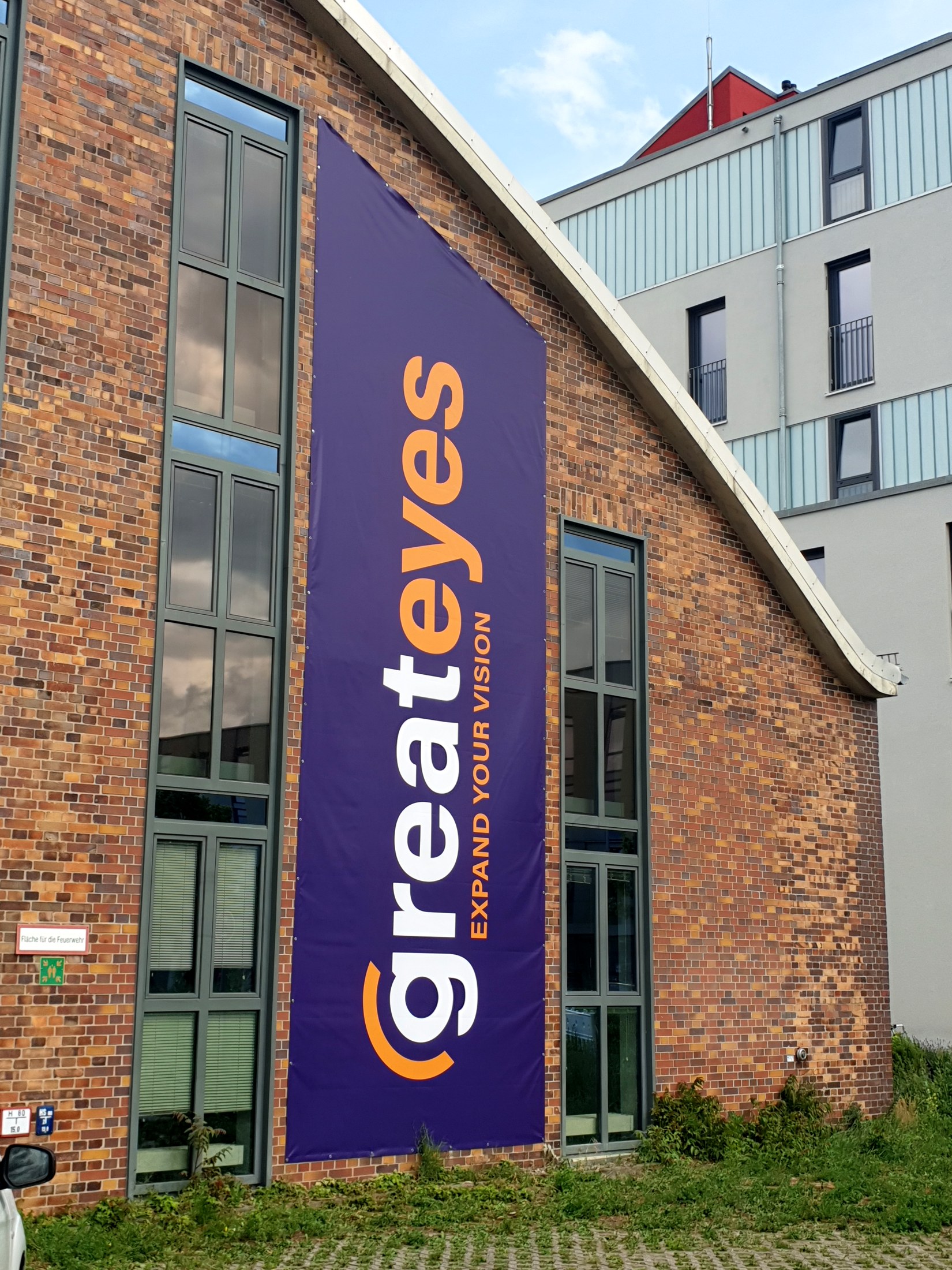
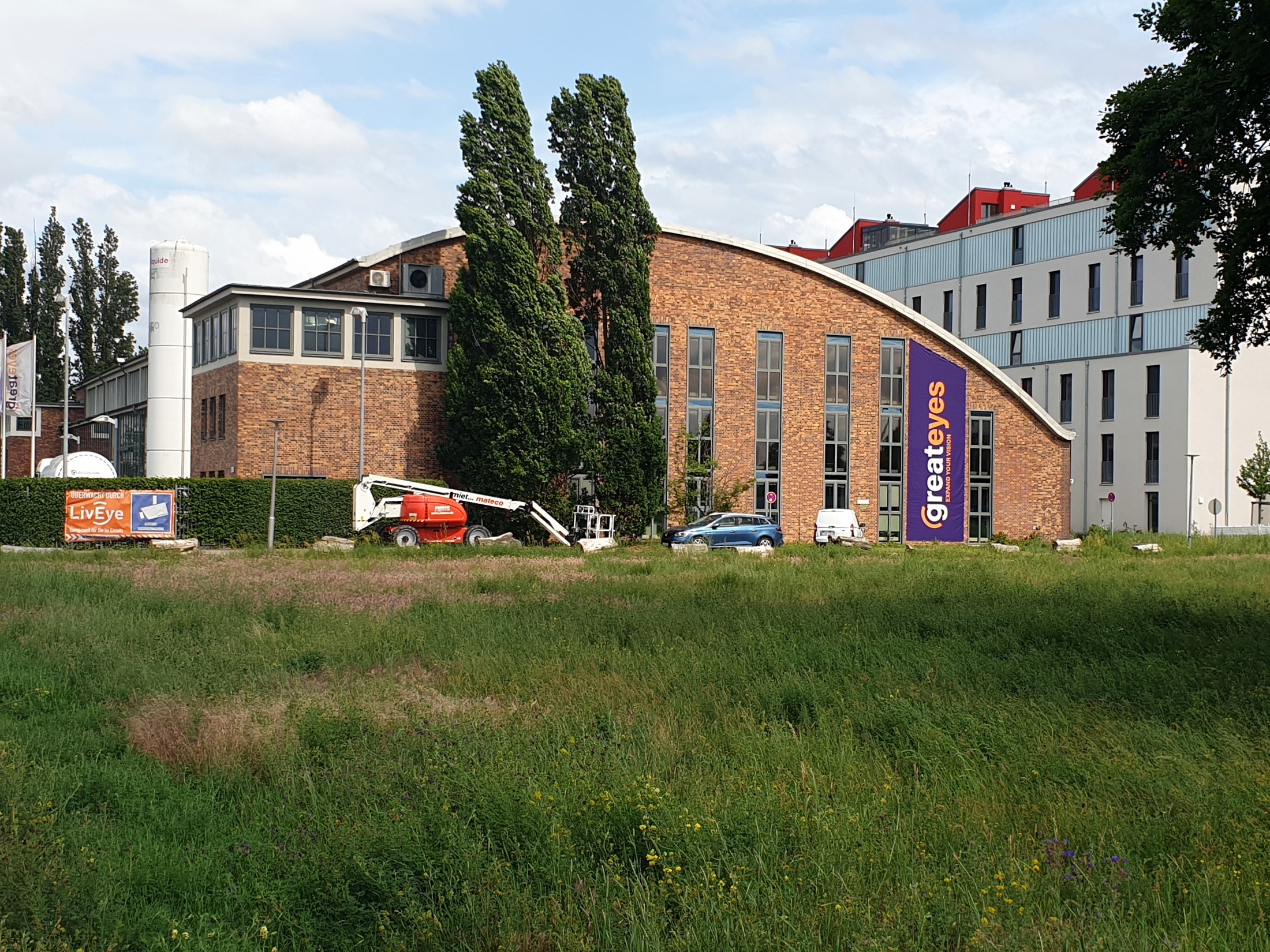
For areas wider than one print width, we weld several widths into one banner. This creates scaffolding and façade banners whose fixing we plan together with you and the scaffolder.
In-house production
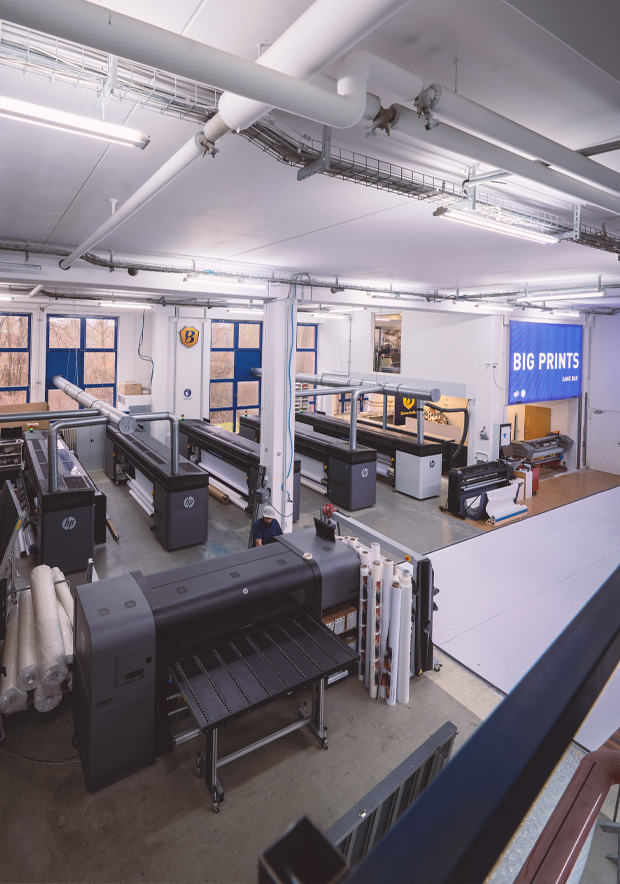
This is where your large format is made.


References
Printed and installed.


Machinery
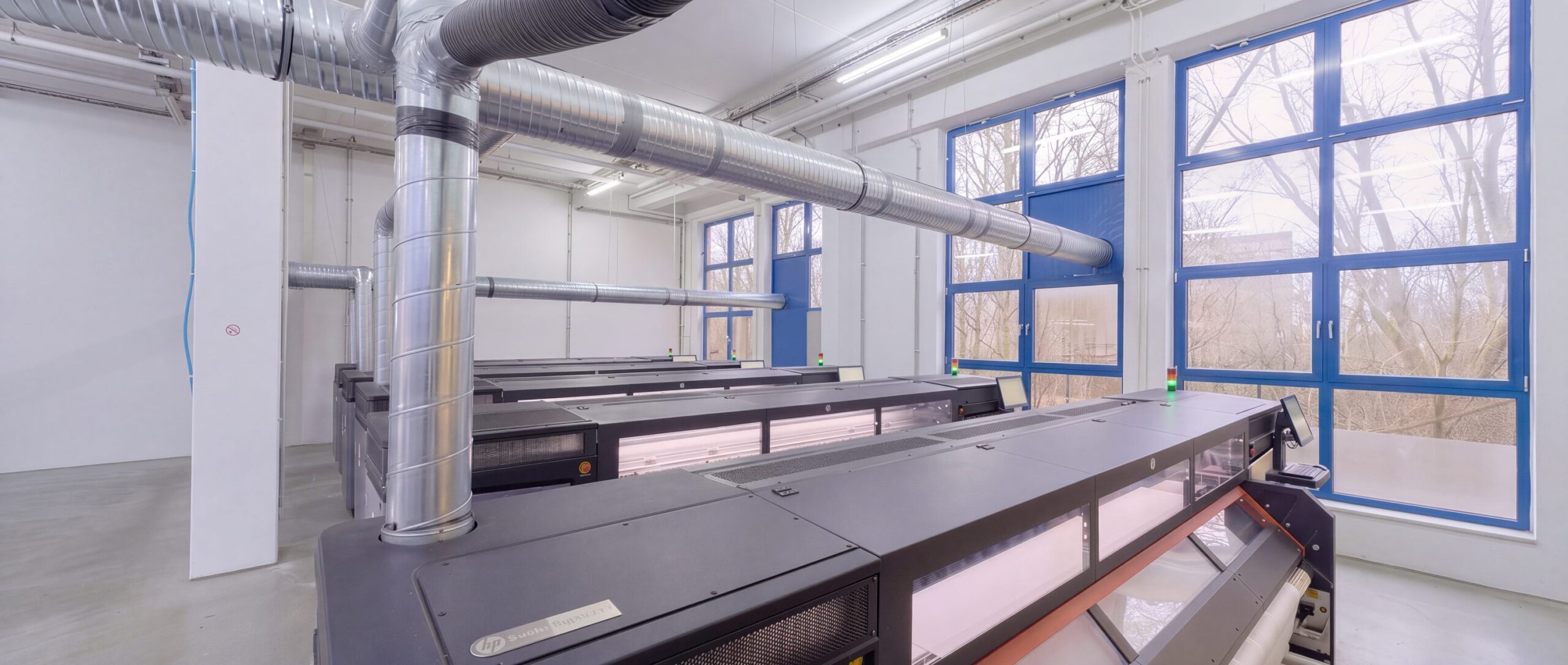
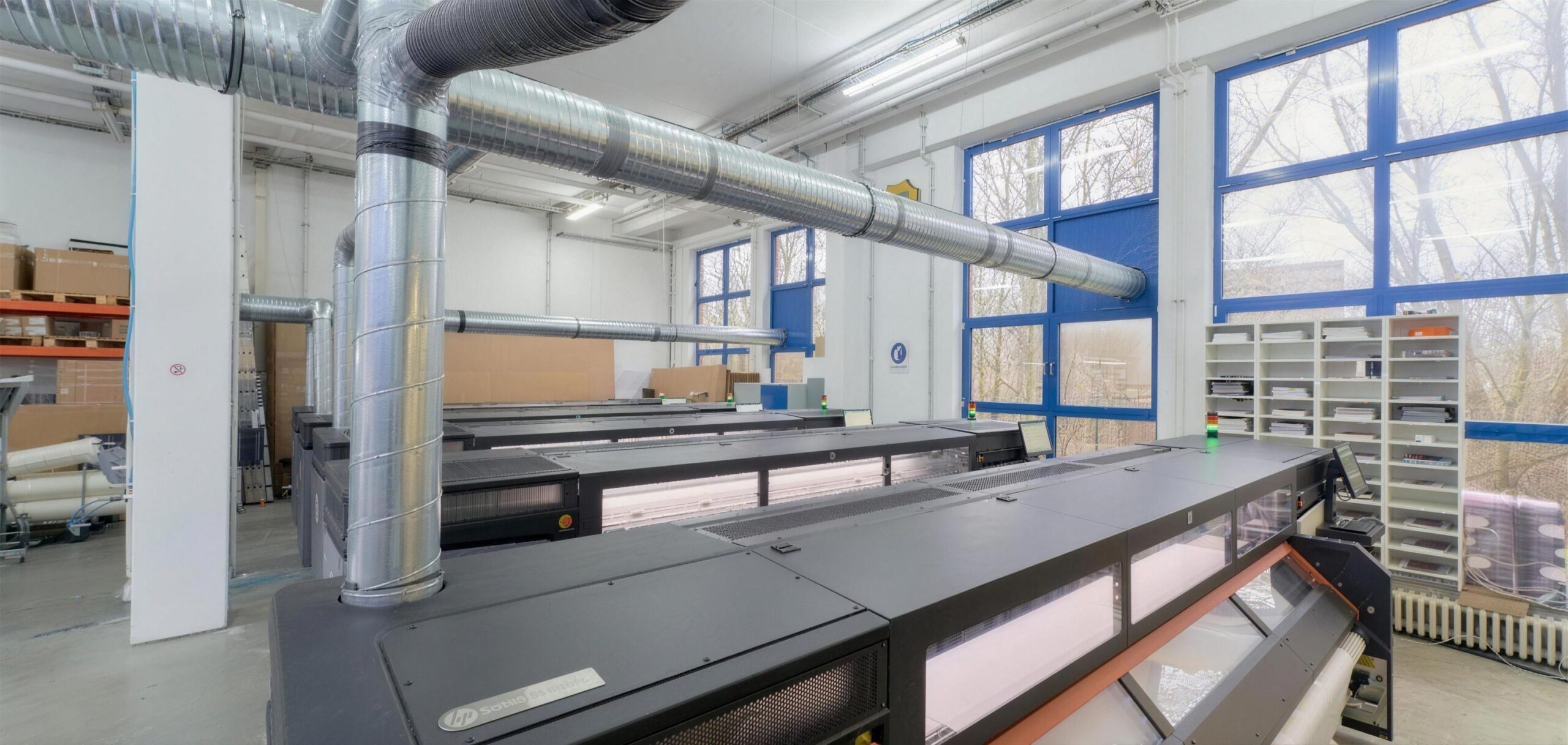
Well equipped for large formats.


Plus Leister welding machines for durable joins on banners and tarpaulins.
Expertise
Choosing material, print and finishing correctly.
Which process fits depends on the material. UV-curing inks dry instantly under UV light and are suitable for direct printing on boards as well as for banners and films. Textiles for tension frames are produced by sublimation printing: the colour is fixed into the polyester fibre under heat in the calender, and the fabric stays soft and foldable.
Frontlit is the classic PVC tarpaulin for single-sided printing, lit from the front or read in daylight. Blockout has an opaque middle layer so that with double-sided printing the reverse visual does not show through. Backlit is translucent and made for illuminated surfaces. Mesh is a fabric with an open grid structure.
A solid banner acts like a sail in the wind. Mesh lets part of the air through and reduces the force on fence, scaffolding and fixings, but does not eliminate it. On construction fences the stability must be checked, for example with additional braces or weights. On scaffolding the scaffolder must design the anchoring for the cladding. How much air a fabric lets through is stated in the material data sheet; we tell you the value for the material offered.
Shopping centres, trade fairs, places of assembly and many scaffolds require flame-retardant materials. In Germany this is building material class B1 according to DIN 4102-1; the European classification follows EN 13501-1. Tell us in your enquiry whether a certificate is required and we will offer suitable material with the manufacturer’s test certificate.
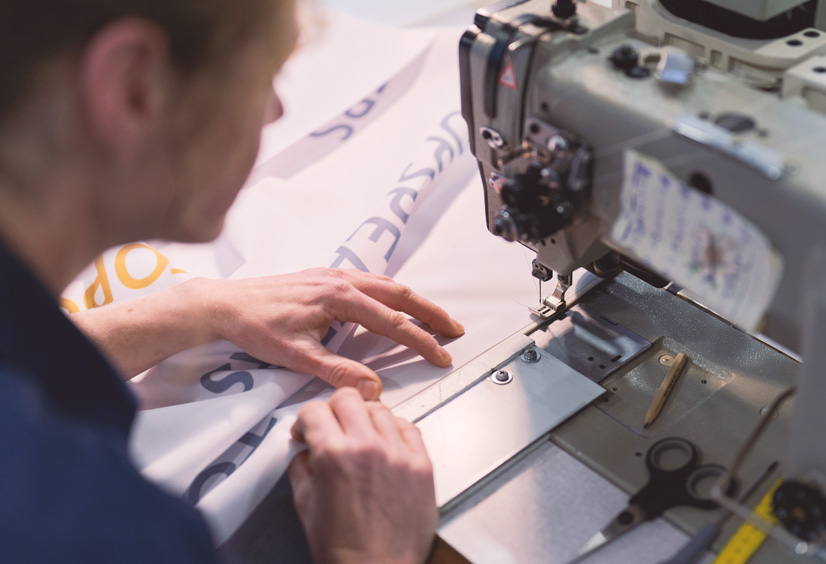
Finishing determines how a print is fixed and how long it lasts. Eyelets in a reinforced, welded or sewn hem are the standard solution for ropes, cable ties and bungee cords. A pole pocket takes tubes or rods, for example on flagpoles and tensioning systems. A keder is drawn into a rail and tensions banner or textile smoothly in a frame. Our finishing department has welding machines, industrial sewing machines and cutting and milling tables with a working area of 3 × 3.2 m.
Aluminium composite consists of two aluminium cover layers with a plastic core; it is rigid, light and suitable for permanent outdoor use. Rigid PVC foam is lighter and cheaper and is mainly used indoors and for temporary applications. With films we distinguish by duration of use and substrate: flat or curved surfaces, permanently adhesive or removable with little residue.
For multi-site retailers
One visual, many locations.
Button
Discuss your rollout
Process
In six steps.
Step 1
Enquiry
You describe your project, locations, desired date and, if available, dimensions and photos of the surfaces.
Step 2
Site survey
We measure the surfaces on site and clarify substrate, fixing and access, for example whether a lifting platform is needed.
Step 3
Mockup and approval
You receive a view of your visual on the real surface and approve layout, dimensions and material in writing.
Step 4
Production
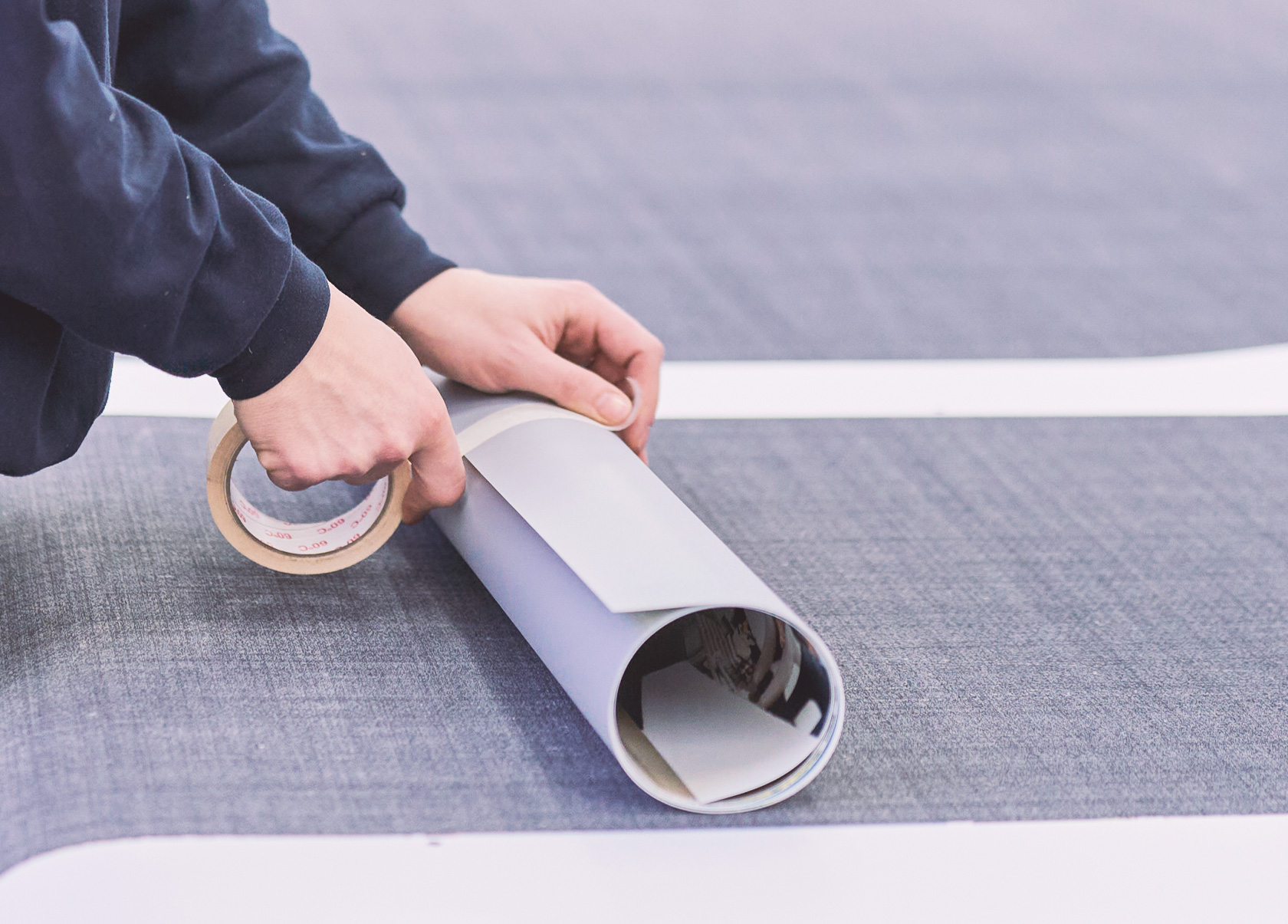
We print and finish in our own production and check every part before dispatch.
Step 5
Installation
Our installation teams fit the prints on the agreed date, outside opening hours if required.
Step 6
Proof photos
You receive photos of every finished location as proof and for your internal sign-off.


FAQ
Frequently asked questions.
What does large-format printing cost?
The price results from area, material, finishing and quantity. Depending on the project, survey, installation, lifting equipment and travel are added. A mesh construction fence banner with eyelets is calculated differently from a façade banner installed on scaffolding at great height. You receive a quote from us in which printing and installation are shown separately.
How long does it take from enquiry to installation?
That depends on quantity, finishing and installation effort, and on whether a survey or a permit is needed. Tell us your preferred date in the enquiry and we will tell you bindingly whether it can be met.
How do I supply the print data?
Ideally as a PDF in CMYK, fonts converted to outlines, at a scale of 1:1 or 1:10. The resolution required depends on the viewing distance: what is read close up needs more than a façade banner that works from 20 metres. Important content should keep a distance from edge, eyelets and hem. After the first consultation you send us the data via a download link; we check it before printing.
How long does a banner last outdoors?
Durability depends on material, location and fixing. Sun, wind and a banner rubbing against its fixing shorten it; a suitably chosen material and even tension extend it. Tell us whether the print is intended for a campaign of a few weeks or for several years, and we will choose material and finishing accordingly.
Do you also install on site?
Yes. We install with our own teams and, on request, also handle removal and changes of visual. For planning we need details of height, substrate and access; if these are missing, we clarify them during the survey.
Do I need a permit for my banner?
That depends on location, size and duration. Signage falls under the building regulations of the respective federal state; some installations are exempt, others need a building permit. In Berlin the district building authority is responsible. If the advertising hangs over public road space, a special use permit may also be required, and for rented surfaces the owner must agree. We tell you what is likely to need clarifying for your project.
Which surface should we bring to life?
Briefly describe your project. We will get back to you with questions and a date.
Enquiry
Request a project
Briefly describe your project. We will get back to you with questions and a date.